
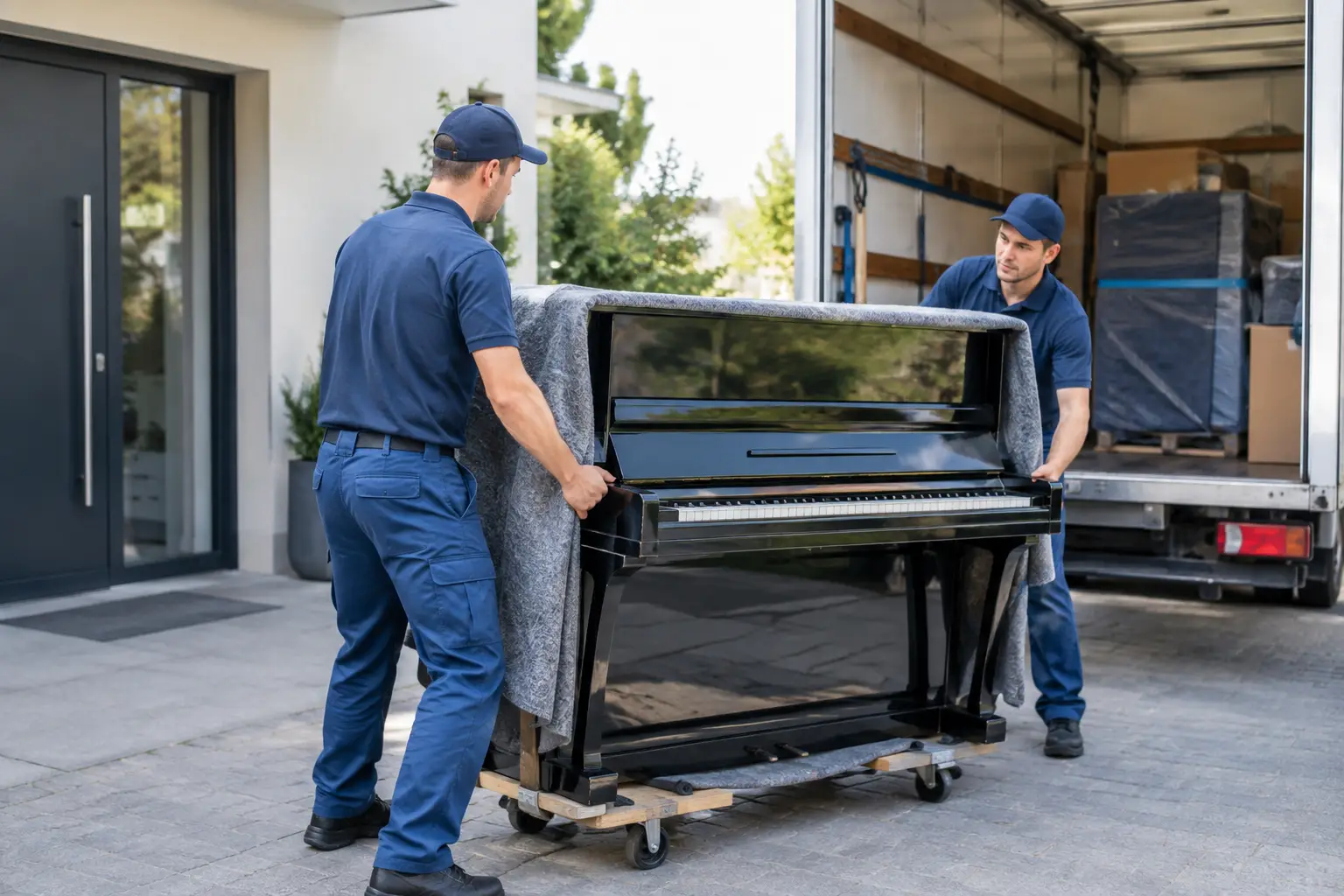
A piano may fit through the front door, but it is not a piece of furniture like any other. Its weight, delicate action and narrow stairwells make moving a piano with a moving company a job that calls for preparation and the right experience. Anyone who looks only at the lowest price here risks damage to the instrument, to walls and floors - or a moving day that suddenly turns out much longer and more expensive than planned.
A good moving company therefore assesses more than the route between the old home and the new one. The floors, a lift, door widths, turns in the stairwell and whether the piano can be set down safely at both addresses matter just as much. With the right details you receive comparable quotes and can book with confidence.
When does moving a piano with a moving company make sense?
A small digital piano can often be handled differently from an acoustic one. A classic upright, however, frequently weighs between 180 and 300 kilograms, and a grand considerably more depending on the model. On top of that, the weight is not evenly distributed. Carrying it therefore takes a practised crew, suitable equipment and a safe method.
Professional transport makes particular sense with narrow stairs, older buildings without a lift, long carrying distances or a valuable instrument. Even if a piano only moves within the same city, the effort stays much the same. The short drive saves time, but it does not solve the problem at the front door or on the fourth floor.
Not every moving company carries out piano moves itself. Some work with specialist partners for this. That is not automatically a disadvantage. What matters is that it is stated clearly who is doing the transport, which service is included in the price and how the insurance cover is arranged.
What really counts when a piano is moved
A professional job begins before moving day. Ideally the company gets an impression of the conditions through photos, a video call or a visit. With complicated access, an on-site visit can be the safest solution. It prevents anyone noticing only on moving day that a banister, a tight turn or a low ceiling makes the move harder.
The instrument is wrapped for protection before it is carried. Moving blankets, edge protectors and strong straps are usual. On a grand piano, the legs and pedals are generally secured or removed by someone who knows how. A piano must not be tilted any which way, pushed along on its castors or lifted by its delicate parts. The castors on the instrument are meant for shifting it within a room, not for transport along hallways, over steps or across uneven ground.
If the stairwell is not suitable, an external hoist or a furniture lift can be the better choice. That raises the cost, but can prevent damage and speed things up considerably. In individual cases a grand piano is moved through a window or over a balcony. That is a special solution which is only an option after careful assessment, with safeguards and with any permits that may be needed.
Details that belong in your moving request
The more specifically you describe your instrument and the routes, the more reliable the quote will be. A single photo of the piano is often not enough. Pictures of the entrance to the building, the stairwell, tight spots and the parking situation in front of the building are useful too.
Give at least these points in your request:
- Type of instrument: upright piano, digital piano, grand piano or small upright
- Dimensions and, if possible, the approximate weight
- Floor, lift and number of steps at both addresses
- Width of doors, hallways and critical turns in the stairwell
- Carrying distance from the vehicle to the home, and the parking situation
- Preferred date and whether other furniture is moving as well
For very old, valuable or restoration-worthy instruments, a short word with a piano technician is worthwhile as well. They can judge whether special protective measures are needed. The same goes for instruments with visible damage, loose parts or an unusual construction.
What does it cost to move a piano?
A flat answer would not be honest. For a simple move within one town, with ground-level access and a short distance, the costs can stay manageable. Several floors without a lift, a heavy grand, long distances or an external hoist change the price considerably.
The total price is often made up of staff, vehicle, distance, floors and the equipment needed. No-parking zones can matter too, if long carrying distances or waiting times would otherwise result. Anyone who has the piano moved together with the whole household may save compared with a separate trip. But that depends on how many movers and how much extra time the instrument ties up.
When comparing quotes, look at more than the final sum. A low price is of little help if stair surcharges, an external hoist or packing materials are added later. Ask for a binding fixed price, or have it explained exactly which conditions the quoted price depends on.
Comparing quotes for a piano move properly
A good quote describes the service clearly. If it says only “piano transport”, it remains open whether the crew wraps the instrument, carries it over stairs, sets it up at the destination and arranges an external hoist if needed. These details make the difference between clear planning and an unpleasant surprise.
Compare in particular whether enough staff are planned, whether protective material is included and how damage to the instrument or the building is covered. Read customer reviews with an eye to similar moving situations as well: punctuality matters, but experience with difficult access matters at least as much.
With a single free and non-binding request at Umzigo you can receive suitable quotes from vetted moving companies. That way you do not have to contact several firms one by one, and can compare price, scope of services and reviews at your leisure. What counts in the end: book the quote that clearly takes your particular living situation into account - not simply the cheapest.
How to prepare the piano and your home
Clear the way to the instrument in good time. Shoes, boxes, lamps, rug edges and loose cables quickly become a risk when something heavy is being carried. Also check whether children or pets can stay in another room while it is carried.
Take sheet music, ornaments and loose objects off the piano. You should not fix the lid elaborately yourself or remove parts unless the company recommends otherwise. Screwing things down on your own initiative can cause damage or make the professionals' work harder.
At the destination, the spot for the piano should already be decided. An acoustic piano should, where possible, not stand right by a radiator, against a permanently damp outside wall or in full sun. After the move, the instrument needs time to adjust to temperature and humidity. It is best not to have it tuned straight away, but after a few days to a few weeks - depending on how much the conditions have changed.
On moving day: safety before speed
Plan a fixed time slot for the piano and keep the access clear. If a no-parking zone is needed, it should be applied for and set up in good time. Before work starts, show the crew all the particular points you mentioned in your request: tight corners, delicate floors, low passages or a difficult parking situation.
Stay reachable, but leave the carrying to the professionals. Well-meant help on one side can upset the sequence of movements if it has not been agreed. After it is set up, check together whether the instrument stands securely and whether there is visible damage to the piano, walls or floor. Record anything you notice straight away with photos and raise it immediately.
A piano move is relaxed when nobody has to improvise. With complete details, transparent quotes and a crew that thinks the routes through beforehand, your instrument arrives safely - and can soon find its place in everyday life again in the new home.